Gilt Complex : A solo show with Sébastien Johnson


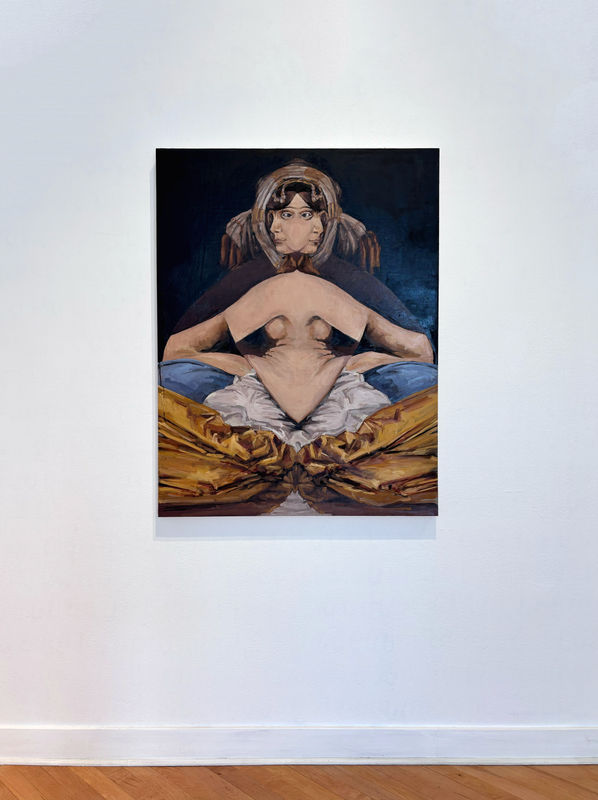
87.6 x 110.5 cm
An interview with…
Sébastien Johnson on Gilt Complex
Tell us about this exhibition?
I’d start by saying that painting, for me, isn’t this highly systematic thing. There’s more of a fire inside me, a compulsion. I’m pulled to make these images before I’ve even figured out why. I follow that pull, then unpack the meaning later. It’s rarely planned, and I don’t believe there's one clean “message” behind the work.
So then the real question is: why am I so drawn to these old European images, why do I unnecessarily obsess over making these images? What is it about icons of empire, of myth, of beauty, of control where I keep finding myself making?
What I’ve come to believe is that these images are heavy. They were propaganda in their time—full of feeling, politics, soul. Now, with centuries of history piled on top, they still feel just as charged, but in different ways: through the lens of race, of power, of late capitalism they hold an entirely new, but equally profound weight.
This exhibition specifically is a collection of recreations of European paintings that were made in the 17th to 19th centuries. An era where paintings were made as a form of propaganda to project power, wealth, and control.
These works were embedded with the values of their time: colonialism, patriarchy, and imperial dominance. By revisiting and reworking them today, the exhibition asks what happens when the images that once upheld empire and order are abstracted and broken apart. What remains is hopefully a complex space of reflection, discomfort, beauty and a new way of considering the icons that have shaped our culture.
Not completely. The goal isn’t exact replication, but instead what I’m after is the aura – the emotional force these paintings hold. When I walk through old museums, certain works carry this weight where I feel some rich emotion, that is what I am after. Capturing the essence of how I see these paintings.

96.5 x 87 cm

Sometimes the paintings are more technical, other times they're messier. Sometimes I lean into distortion, or symmetry, or cropping. I am most excited when the original images dissolves and turns into something new. There’s no one formula. I go where the image leads me.
Tell me about the symmetry and mirroring?
On a literal level, I like the idea of these works being a mirror , holding up Europe’s past to itself. But also, I’m a UX designer. Symmetry scratches that part of my brain that loves systems and structure. It’s satisfying to take chaos and give it some order. But even more than that, mirroring lets the image become unfamiliar. You start to see things differently—not just what’s there, but what’s off.
How are you shifting the story of the originals?
Take Napoleon, for example David painted him like he was this noble god-king. In mine, he becomes abstracted, or Ingres’ Odalisque—she’s a fantasy, a body that can’t exist anatomically, built to please the gaze. I tried to push that further, leaned into the impossibility. I want you to feel the uneasiness of this painting or ‘Poliso Verso’ and ‘apothothsis’, by cropping the work, the focus shifts. This crop also places the viewer in the painting. Now a viewer is either getting booed at or be crowned. They are placed inside the artwork. (Similar to Corbet’s ‘Burial at Ornan’ (1850) where people were outraged because it was as if the viewer was the individual in the coffin).
What does the title Gilt Complex mean?
“Gilt” is a surface—it’s the shiny gold leaf, the polish, the grandeur. “Guilt complex” is the idea that something's gone wrong, something’s off. That tension, between glamour and decay, between what we celebrate and what we ignore, that’s what I’m after. I want the viewer to feel that something’s not quite right, even when it’s beautiful. Maybe especially when it’s beautiful.
What do you hope people take away?
I want each painting to stir up something. Ideally viewers have some real, deep emotion that art history once made room for: awe, grief, desire, confusion, beauty, fear. I want viewers to sit with those feelings, and then – hopefully – step back and notice the bigger, more complex picture. That art history isn’t all good or all bad. It’s both. It’s a mix of horror and beauty. And I think that complexity still matters.


